General Radio Information
- Fhz (Channels) Information for NZ Motorsport
- Who and what is RSM? (And why should I care?)
- Overseas Radio Equipment Purchases
- DMR vs Analogue Radios: What's the Difference?
- What is a CTCSS or Tone filtering?
Fhz (Channels) Information for NZ Motorsport
In the first instance, to clear up an interchangeable term, channels and FHz (frequency)
A FHz is what the radio is tuned to, a little like in the old days, when we used to have an old-style car radio and tune up and down the dial to find a radio station. What we were doing was changing the receive fhz in order to find a station.
A channel is like the presets you memorise when you tune in to a radio station. The channels allow you to easily return to the radio station later, so each channel contains a frequency. In reality, these terms are interchangeable and often mean the same thing.
What is CTCSS or Tone?
Modern radios cannot only hear a transmission on a specific fhz but also apply a filter. This filter is implemented by sending a CTCSS tone. These tones are often referred to as sub-audioable as they are outside the range of what we can hear.
When set to a receiver, it will only allow you to hear audio from the specific FHZ set that contains the correct CTCSS tone. So what they do is act as a filter on the channel. While your radio may hear other transmissions or noise on the channel, if they do not contain the correct tone, they will NOT be heard by the user of the radio.
What are the dangers of using CTCSS tones?
While they sound like the answer to many problems, they only work when transmitters are configured to send them. Our experience has seen that, while they are mandated, not all tracks have them set to be sent. If your receiver is configured to hear only transmissions with a tone and the event organisers have radios that are not set to send them, you will NOT hear their transmissions.
What happens if my Receiver does NOT have a CTCSS tone set?
Nothing, what this means is that you will hear all transmissions on the channel. It will not in any way affect your ability to hear race control. The downside of not having the tones configured is that, because your radio will hear everything on the set channel, you may be susceptible to noise or interference.
NZ Circuit Track and GT cars fhz: 455.16875 MHz
NZ Circuit CTCSS and GT cars Tone: 179.9 Hz
NAZCAR Fhz: 455.00625 MHz
Speedway Track fhz: 455.0625 MHz
Speedway CTCSS Tone: 123.0 Hz
Who and what is RSM? (And why should I care?)
RSM (Radio Spectrum Management)
RSM in the NZ governing body when it comes to anything related to radio in NZ. They are set up to ensure that all radio services in NZ co-exist and don’t cause problems with each other. They have the power to prosecute and confiscate equipment for any breaches where radio equipment used does not comply with the regulations.
In simple terms, they are the “Radio Police” and have wide reaching powers.
website: https://www.rsm.govt.nz/
Do Radio Regulations Change from Country to Country?
Yes, this is one of the most common questions we are asked. Regulations on both the equipment we are allowed to use and the channels (fhz) we can use vastly changes from country to country. Chances are if you have purchased equipment from overseas it will be illegal to use in NZ.
Something to be Aware of regarding Radio Regulations
Something many fail to understand about radio regulations and rules is that they are not like the road regulations. You can own a car that can do over the speed limit, but you only get fined if you get speeding. This is NOT how the radio regulations work. All you have to do is be caught with equipment that is capable of transmitting on a illegal channel or fhz and by the letter of the law that is enough reason to have your equipment confiscated and or fined.
While this does not often happen, it does happen and especially if you cause interference to a licensed user.
please see here for more information
Overseas Radio Equipment Purchases
Purchasing radio equipment from non-nz licensed radio dealers is fraught with danger. The NZ regulations are policed and mandated by RSM. The rules are complex and carry heavy fines for those found in breach.
There are basically two components that matter about using radio equipment in NZ. Firstly if it’s only a receiver, then anything goes. But when it comes to any type of transmitters then you must comply with the NZ regulations. If you are found to have radio equipment that does not comply with the regulations (even if not using it at the time) then you are liable for prosecution.
NZ radio equipment must pass the hardware standards mandated (must AliExpress radio will not pass these standards) and be set to only use the channels/fhz you are allowed to use.
https://www.rsm.govt.nz/assets/Uploads/documents/RSM-Illegal-Two-Way-Radio-Leaflet-FINAL.pdf
DMR vs Analogue Radios: What's the Difference?
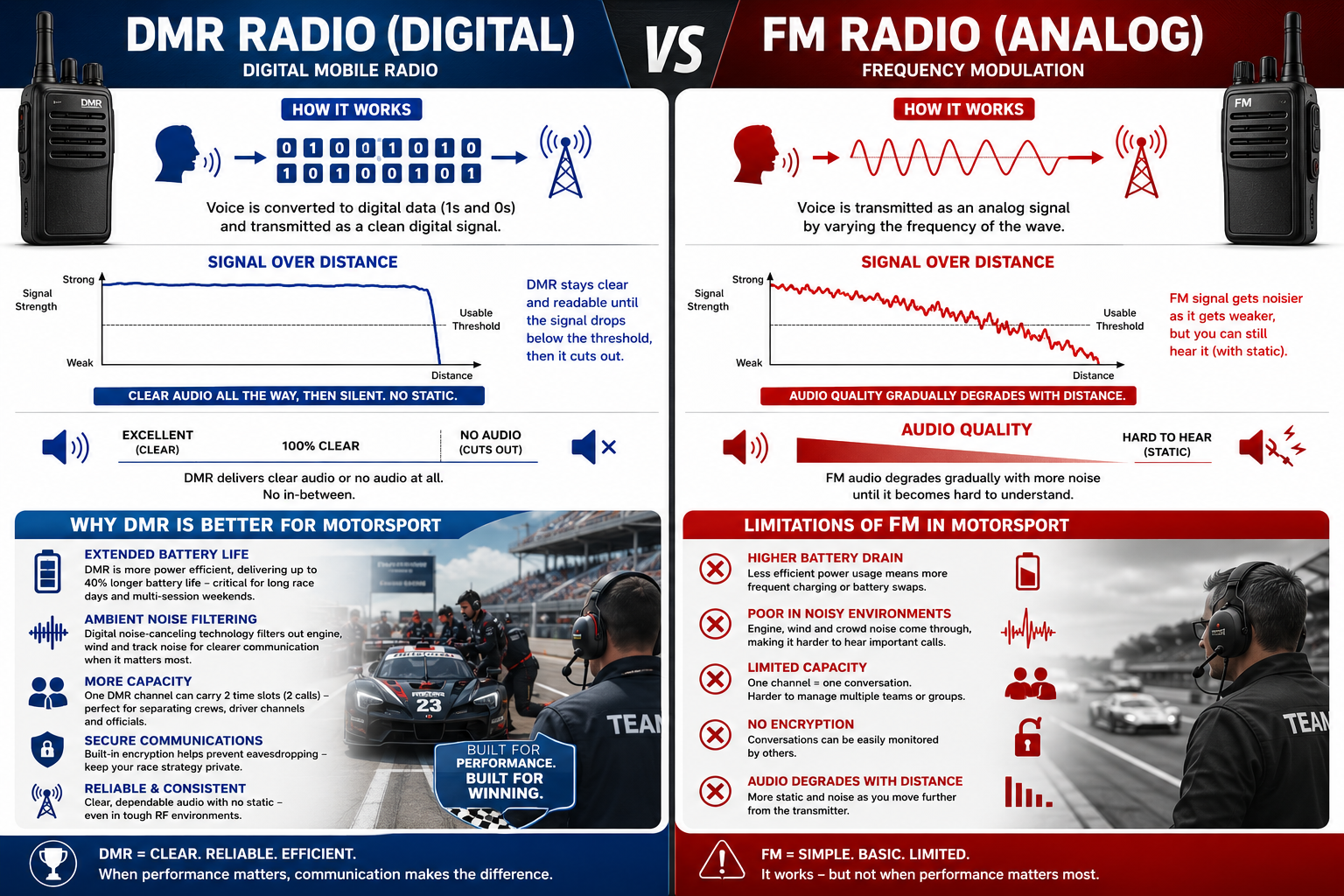
If you've ever used a 2-way radio, you've probably experienced analog-FM (frequency modulation) radio. FM is the old way of sending voice over radio waves, and it's been around for decades. When you talk into an FM radio, your voice gets turned into a wave pattern that travels through the air to other radios on the same frequency. It works pretty well, but there's a catch: only one person can talk at a time on the same channel, and the signal can get fuzzy or drop out if you're far away or in a crowded area.
DMR (Digital Mobile Radio) is the newer, smarter way to send radio signals. Instead of turning your voice into a wave pattern like FM does, DMR converts your voice into digital data—basically 1s and 0s, like how computers work. This might sound complicated, but it has some awesome benefits. Two people can talk on the same frequency at the same time without stepping on each other. The sound is crystal clear and doesn't get fuzzy. You can send text messages and data, and the signal works better over longer distances. Plus, DMR radios are more secure because they can encrypt conversations, making it harder for people to listen in.
The bottom line? FM radios are simple, and they work, but DMR is like upgrading from a bicycle to a motorcycle. DMR is faster, more reliable, lets more people communicate at once, and offers features that FM just can't match. For businesses and emergency services that need their radios to work perfectly every single time, DMR is worth the switch.
What is a CTCSS or Tone filtering?
What is CTCSS or a Tone?
Modern radios can not only hear a transmission on a specific frequency but also apply a filter. This filter is implemented by sending a CTCSS tone. These tones are often referred to as sub-audible, as they are outside the range of what we can hear.
When set on a receiver, it will only allow you to hear audio from the specific FHZ set that contains the correct CTCSS tone. So what they do is act as a filter on the channel. While your radio may hear other transmissions or noise on the channel, if they do not contain the correct tone, they will NOT be heard by the radio user.
What are the dangers of using CTCSS tones?
While they sound like the answer to many problems, they only work when transmitters are configured to send them. Our experience has seen that, while they are mandated, not all tracks have them set to be sent. If your receiver is configured to hear only tone-encoded transmissions and the event organisers have radios that are not set to send tone, you will NOT hear their transmissions.
What happens if my Receiver does NOT have a CTCSS tone set?
Nothing, what this means is that you will hear all transmissions on the channel. It will not in any way affect your ability to hear race control. The downside of not having the tones configured is that, because your radio will hear everything on the set channel, you may be susceptible to noise or interference.